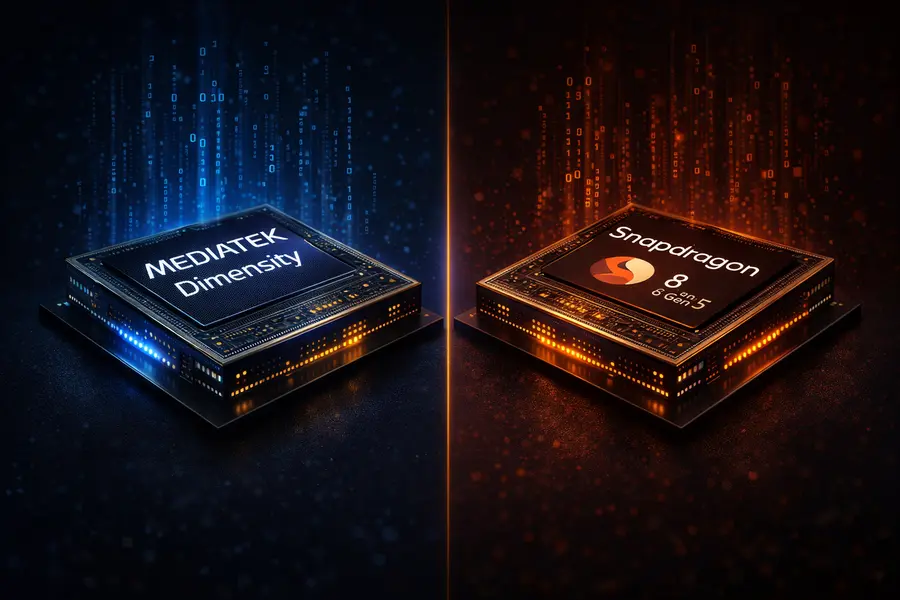
Quick Answer: The Snapdragon 8 Gen 5 has the better CPU for daily tasks and gaming stability. The Dimensity 9500S has the stronger GPU for graphics-heavy gaming. Both are so close in real-world use that for most people, the phone’s price and brand matter more than which chip is inside.
You are about to spend ₹30,000 to ₹60,000 on a new phone. Two chips are powering the best smartphones at this price in 2026 the MediaTek Dimensity 9500S inside phones like the Poco X8 Pro Max, and the Qualcomm Snapdragon 8 Gen 5 inside phones like the OnePlus 15R.
Both are flagship-grade. Both are built on cutting-edge 3nm technology. And both are being marketed as the best chipset you can get without paying ₹80,000 for a true ultra-premium phone.
But which one actually performs better in real life not just on a spec sheet?
First, What Even Is a Chipset? (Skip If You Already Know)
Think of a chipset as the brain of your phone. Everything your phone does opening apps, taking photos, playing games, running WhatsApp goes through this brain. A faster, smarter brain means a faster, smarter phone.
The CPU is the part of the brain that handles everyday tasks opening apps, browsing, multitasking.
The GPU is the part that handles graphics games, video, animations.
The NPU handles AI features like the camera automatically recognising what you are photographing and adjusting settings.
When people argue about Snapdragon vs MediaTek, they are really arguing about which brain works better for which tasks. And in 2026, that argument has become genuinely interesting.
Quick Specs Comparison
| Dimensity 9500S | Snapdragon 8 Gen 5 | |
|---|---|---|
| Found in | Poco X8 Pro Max, Redmi Turbo 5 Max | OnePlus 15R |
| Manufacturing | TSMC 3nm (N3E) | TSMC 3nm (N3P) |
| CPU cores | 1+3+4 (Cortex X925 + X4 + A720) | 2+6 (Oryon prime + performance) |
| Prime core speed | 3.73 GHz | 3.8 GHz |
| GPU | Immortalis-G925 MP12 | Adreno 829 |
| AnTuTu score | ~9.5 lakh | Slightly higher |
| AI chip (NPU) | MediaTek NPU (agentic AI) | Hexagon NPU (agentic AI) |
| 5G standard | Release 17 | Release 18 (newer) |
| Camera ISP | 18-bit, 8K @ 60fps | 20-bit triple AI ISP, 4K @ 120fps |
CPU Performance — Who Wins at Everyday Speed?
The CPU is what you feel every single day — how fast apps open, how smooth switching between Instagram and YouTube feels, how the phone holds up when you are running five things at once.
The Snapdragon 8 Gen 5 uses Qualcomm’s custom Oryon cores — the same architecture found in their top-of-the-line chips, just running at slightly lower speeds. Think of it like a sports car engine with the accelerator slightly dialled back. It is still very fast, and Qualcomm’s software tuning has been refined over many years.
The Dimensity 9500S uses a mix of CPU core generations — the main prime core is the latest and fastest, but the supporting cores are from the previous generation. It is a deliberate cost-saving choice by MediaTek to keep phones affordable. In most tasks, you will not notice. But in sustained heavy use — long gaming sessions, heavy multitasking — the Snapdragon’s more consistent architecture gives it a small edge.
In benchmark tests, the Snapdragon 8 Gen 5 scores slightly higher in CPU performance. In real-world app opening tests with both phones side by side, the Snapdragon-powered OnePlus 15R is marginally faster.
What this means for you: For daily use — social media, YouTube, calls, messaging — both chips feel equally fast. If you push your phone hard with heavy multitasking or demanding apps, Snapdragon has a small but real advantage.
GPU Performance — Who Wins at Gaming?
The GPU is what gamers care about most. More GPU power means smoother frame rates, better graphics quality, and more stable performance during long sessions.
This is where the Dimensity 9500S fights back hard.
The Immortalis-G925 MP12 GPU inside the Dimensity 9500S delivers higher peak graphics performance than the Adreno 829 in the Snapdragon 8 Gen 5. In GPU benchmark tests like 3D Mark Wildlife and Solar Bay, the Dimensity chip scores higher and delivers better frame rates.
In real gaming tests across three demanding games — Genshin Impact, Wuthering Waves, and Arknights Endfield — the results were nuanced:
- Genshin Impact: Snapdragon 8 Gen 5 achieved higher average FPS and ran cooler
- Wuthering Waves: Snapdragon again edged ahead on both FPS and temperature
- Arknights Endfield (the most graphically demanding of the three): Dimensity 9500S won clearly, delivering higher average FPS
The reason Snapdragon won in Genshin and Wuthering Waves despite having a weaker GPU on paper comes down to one word: tuning. OnePlus has spent years optimising their phones for gaming performance, and it shows. The Poco X8 Pro Max, which carries the Dimensity chip, has room to perform even better with better software optimisation from the manufacturer.
In GPU stability tests, Snapdragon holds a steadier frame rate over long sessions. But the Dimensity 9500S has more raw graphical power — it just needs manufacturers to unlock it properly.
What this means for you: If you play BGMI, COD Mobile, or casual games — both chips handle them perfectly at high settings. If you play extremely graphics-heavy games at maximum quality for long sessions, the Snapdragon runs slightly cooler and more consistently. But the Dimensity 9500S has more ceiling if the phone maker knows how to use it.
AI Features — Does It Matter for Real People?
Both chips have dedicated AI processors (NPUs) that power features you use every day without realising it:
- The camera automatically detecting you are shooting a sunset and adjusting colours
- AI erasing an unwanted person from your photo
- Voice assistant understanding your accent better
- Battery lasting longer by learning your usage patterns
Both the Snapdragon 8 Gen 5’s Hexagon NPU and the Dimensity 9500S’s MediaTek NPU support what is called agentic AI — meaning the chip can handle complex AI tasks directly on your phone without sending data to the cloud. Both support multimodal AI, meaning they understand text, images, and voice together.
For most users in India, the practical difference in AI features between the two chips will be invisible in daily use. The camera tuning by the phone brand matters far more than which NPU is underneath.
Camera — Which Chip Takes Better Photos?
Here is something most people do not realise: the chipset affects your camera quality, but the phone brand’s software matters even more.
That said, there are real differences between the two ISPs (the part of the chip that processes photos):
The Snapdragon 8 Gen 5 has a 20-bit triple AI ISP — three separate image processors working simultaneously. It excels at fast burst shooting, quick processing, and computational photography features. It supports 4K video at 120fps.
The Dimensity 9500S has an 18-bit ISP with strong low-light performance and 8K video at 60fps support. The higher video frame rate ceiling is a genuine advantage for videographers.
What this means for you: If you shoot a lot of fast action photos or want the most computational photography features, Snapdragon has an edge. If you shoot 8K video or care about low-light video quality, Dimensity holds its own.
Battery & Efficiency — Which One Lasts Longer?
Both chips are built on 3nm technology, which is the most power-efficient manufacturing process available today. Both will give you excellent battery life compared to chips from two or three years ago.
The difference is subtle: Snapdragon 8 Gen 5 uses the slightly more refined N3P process node versus Dimensity’s N3E — giving it marginal efficiency gains in sustained workloads. In real testing, both chips in gaming scenarios ran at similar temperatures, with Snapdragon running a couple of degrees cooler in some games.
For everyday use — browsing, social media, streaming, calls — both chips are efficient enough that battery life will be determined more by the phone’s battery size than the chip itself.
5G & Connectivity — Any Difference?
Yes, and it matters if you are on a newer 5G network.
The Snapdragon 8 Gen 5 supports 5G Release 18 — the newer standard with better speeds and improved network efficiency. The Dimensity 9500S supports Release 17 — still very capable, but one generation behind.
For most Indian users on Jio and Airtel 5G networks today, this difference will not be noticeable. But as 5G networks in India upgrade to newer standards over the next two to three years, Snapdragon phones will be better positioned to take advantage.
Both chips support Wi-Fi 7 and Bluetooth 5.4 — so wireless connectivity is equally strong on both.
Which Phones Have These Chips?
Phones with Dimensity 9500S:
- Poco X8 Pro Max
- Redmi Turbo 5 Max
Phones with Snapdragon 8 Gen 5:
- OnePlus 15R
- More brands expected throughout 2026
The Honest Verdict
Choose a phone with Snapdragon 8 Gen 5 if:
You want the most consistent daily performance, slightly cooler gaming temperatures, better 5G future-proofing, and a mature software ecosystem. OnePlus’s tuning of this chip is particularly impressive right now.
Choose a phone with Dimensity 9500S if:
You want more raw GPU power for graphically demanding games, strong camera video capabilities, and — most importantly — better value for money. Phones with the Dimensity 9500S tend to be priced lower than equivalent Snapdragon phones, making it the smarter choice if you are budget-conscious in the flagship segment.
The bottom line: In 2026, the gap between MediaTek and Qualcomm has virtually closed. Both chips deliver flagship-grade performance that most users will never fully stress. The phone that wins is not about which chip is inside — it is about which brand has done the best job of tuning that chip. Right now, OnePlus with Snapdragon and Poco with Dimensity are both doing excellent work. Pick the phone, not the chip.
Frequently Asked Questions
Q: Which is better in 2026 — Dimensity 9500S or Snapdragon 8 Gen 5?
Both are flagship-grade chipsets. The Snapdragon 8 Gen 5 has a slightly better CPU for daily tasks and gaming stability. The Dimensity 9500S has a stronger GPU for graphics-heavy gaming. In real-world use, the difference is small enough that the phone’s price and brand tuning matter more than the chip itself.
Q: Is Dimensity 9500S good for gaming?
Yes. The Dimensity 9500S has the Immortalis-G925 MP12 GPU which delivers higher peak graphics performance than the Snapdragon 8 Gen 5 in GPU benchmarks. In real gaming tests, it won in the most graphically demanding title tested. It is an excellent gaming chip, especially in phones where the manufacturer has tuned it well.
Q: Which phones have Snapdragon 8 Gen 5 in India?
The OnePlus 15R is the most notable Snapdragon 8 Gen 5 phone available in India in 2026. More smartphones from other brands are expected to launch with this chip throughout the year.
Subscribe or stay tuned to TECHSCR for more detailed reviews, in-depth comparisons, and the latest smartphone updates!
